Monday, November 7, 2016

Byron's Manfred

The Persistence of Manfred

Below are two paintings depicting scenes from Byron's Manfred. The first is by an artist who was a contemporary of Byron. The Longman Anthology produces another famous painting by Martin in the color plates section. You might compare the painting below, depicting Manfred's encounter with the chamois-hunter, with Martin's "The Bard" included in the Longman.

https://blogger.googleusercontent.com/img/b/R29vZ2xl/AVvXsEh-zeAYdxUpGaWt9AFhVzCWFdK7RnuEjtygzFtPsL30hFJuie6_z9sEcF6bP4bcYU_V768Lcty5BxrV3BdhpSFAx-Wckm8xXAfluS42DzCwZFpu3PBw6d7Zucrct3pifRHmh4mwuERuFi4/s1600/John_Martin_-_Manfred_on_the_Jungfrau_(1837).jpg


Here is the same scene depicted by the late Victorian painter Ford Madox Brown.
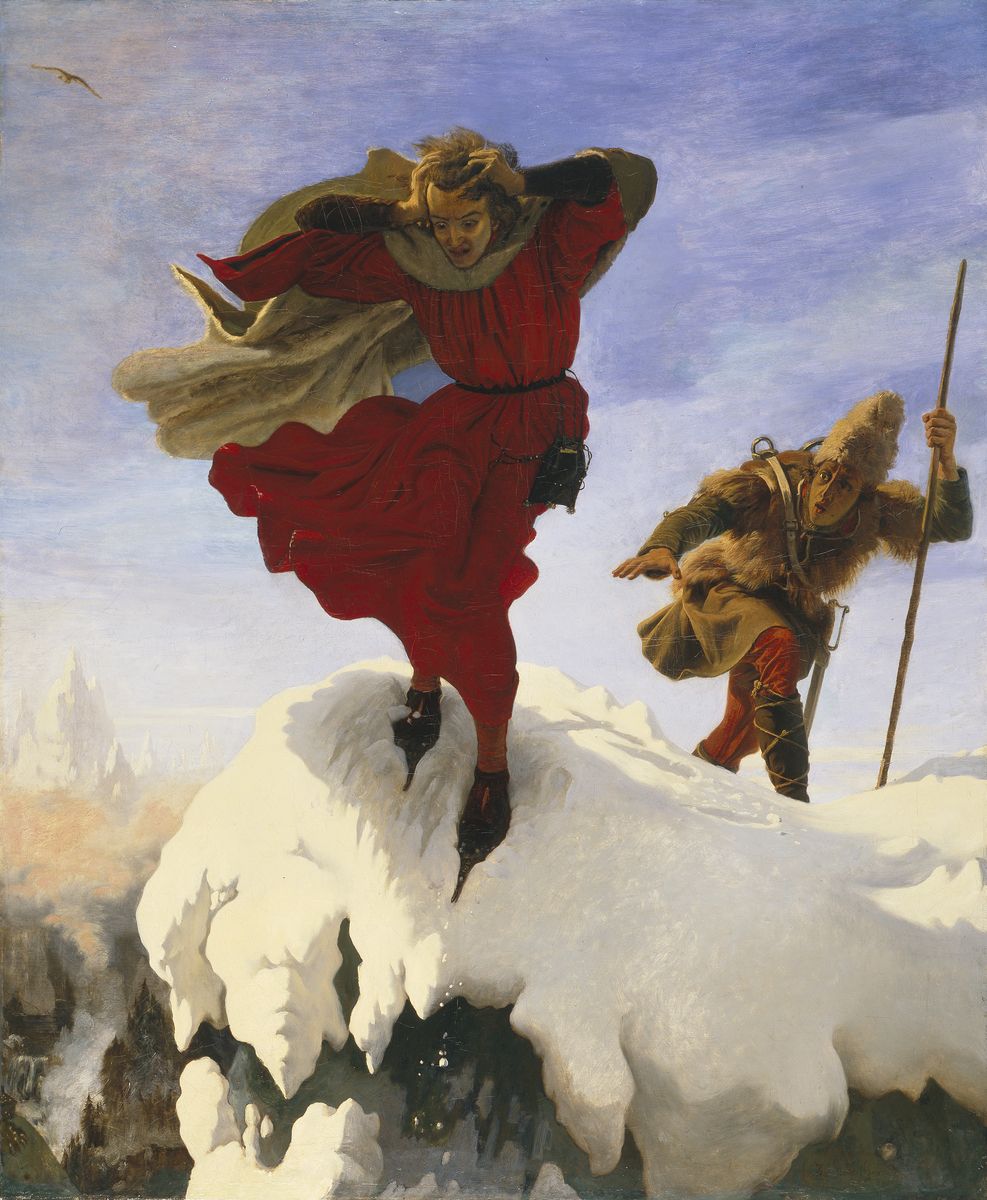

Byron's pessimism contrasts sharply with the revolutionary optimism emanating from the French Revolution, Napoleon's rise to power, the emergence of a democratic government in the former British colonies of North America, and other heady Romantic moments. This emergence out of the darkness of tyranny into the light of liberty (and yes they actually talked like that) is captured beautifully in the "prisoners' chorus" from Beethoven's opera Fidelio:

The Prisoners' Chorus from Fidelio

GEFANGENEN
O, welche Lust!
in freier Luft den Atem
leicht zu heben, O, welche Lust!
nur hier, nur hier ist Leben,
der Kerker eine Gruft, eine Gruft!
ERSTER GEFANGENE
Wir wollen mit Vertrauen
auf Gottes Hülfe,
auf Gottes Hülfe bauen,
die Hoffnung flüstert sanft mir zu,
wir werden frei, wir finden Ruh,
wir finden Ruh'.
GEFANGENEN
O Himmel Rettung,
welch ein Glück,
o Freiheit, o Freiheit,
kehrst du zurück?
ZWEITE GEFANGENE
Sprecht leise, haltet euch zurück,
wir sind belauscht mir
Ohr und Blick.
GEFANGENEN
Sprecht leise, haltet euch zurück,
wir sind belauscht mir
Ohr und Blick.
ALL
Oh, what a pleasure once again
Freely to breathe the fresh air!
In Heaven’s light we live again;
From death we have escaped.
One of them.
Let us in Heaven trust;
On Heaven depend our hopes:
He will on our griefs look with pity.
On His goodness all things depend.
All.
Oh, liberty! oh, salvation!
Oh, God, upon our miseries have pity!
[Here an Officer appears on the wall, and again retires.
Prisoner.
Silence! make no noise!
Pizarro’s eyes and ears are o’er us!
All.
Silence! make no noise!
Pizarro’s eyes and ears are o’er us!
Oh! what a pleasure once again
Freely to breathe the fresh air!
In Heaven’s light we live again;
From death we have escaped.


Byron's pessimism began as more mannerism than worldview. He achieved near-instant and worldwide fame with the immense popularity of his travelogue/reflective poem, Childe Harold's Pilgrimage, the first part of which was published in 1812.  As Byron later commented, he woke one day to find himself famous. This long rambling poem details the journeys and meditations of the world-weary "Harold" (to which Byron self-consciously prefixes the medieval title of "Childe" (young lord) complete with archaic spelling) as he travels throughout Europe and the Near East in search of experience to stir him out of his ennui and existential angst, neither term yet existing by the way. Readers weren't fooled and immediately recognized the author in the character of Childe Harold, but the exotic locations (closed to most Europeans by the Continental War still taking place) coupled with the self-loathing, self-aggrandizing narcissistic narrator were a compelling combination for readers.

When Byron returns to Childe Harold's Pilgrimage in 1816, he drops the pretense and speaks in his own voice about his own life, a life that was widely known because Byron was Lord Byron (a member of the aristocracy) and according to one of his former lovers, "mad, bad, and dangerous to know." Like one of his Byronic heroes, Byron espoused democratic principles while simultaneously invoking his hereditary rights; he criticized the monarchy while partaking of the advantages of rank; he championed the people while disdaining the herd. 

Below are some excerpts from Canto 3 of Childe Harold's Pilgrimage (1816). Stanzas 36-45 are Byron's reflections on the fall of Napoleon, which reads like a gloss on Manfred. Stanzas 96-97 are pure Romanticism. And stanzas 113-114 are Byron's (arrogant) farewell to the English public as he leaves England to begin his own exile in the face of scandal.

From Childe Harold's Pilgrimage, Canto 3

XXXVI.
There sunk the greatest, nor the worst of men,
Whose spirit anithetically mixed
One moment of the mightiest, and again
On little objects with like firmness fixed;
Extreme in all things! hadst thou been betwixt,
Thy throne had still been thine, or never been;
For daring made thy rise as fall: thou seek'st
Even now to reassume the imperial mien,
And shake again the world, the Thunderer of the scene!
XXXVII.
Conqueror and captive of the earth art thou!
She trembles at thee still, and thy wild name
Was ne'er more bruited in men's minds than now
That thou art nothing, save the jest of Fame,
Who wooed thee once, thy vassal, and became
The flatterer of thy fierceness, till thou wert
A god unto thyself; nor less the same
To the astounded kingdoms all inert,
Who deemed thee for a time whate'er thou didst assert.
XXXVIII.
Oh, more or less than man--in high or low,
Battling with nations, flying from the field;
Now making monarchs' necks thy footstool, now
More than thy meanest soldier taught to yield:
An empire thou couldst crush, command, rebuild,
But govern not thy pettiest passion, nor,
However deeply in men's spirits skilled,
Look through thine own, nor curb the lust of war,
Nor learn that tempted Fate will leave the loftiest star.
XXXIX.
Yet well thy soul hath brooked the turning tide
With that untaught innate philosophy,
Which, be it wisdom, coldness, or deep pride,
Is gall and wormwood to an enemy.
When the whole host of hatred stood hard by,
To watch and mock thee shrinking, thou hast smiled
With a sedate and all-enduring eye;
When Fortune fled her spoiled and favourite child,
He stood unbowed beneath the ills upon him piled.
XL.
Sager than in thy fortunes; for in them
Ambition steeled thee on to far too show
That just habitual scorn, which could contemn
Men and their thoughts; 'twas wise to feel, not so
To wear it ever on thy lip and brow,
And spurn the instruments thou wert to use
Till they were turned unto thine overthrow:
'Tis but a worthless world to win or lose;
So hath it proved to thee, and all such lot who choose.
XLI.
If, like a tower upon a headland rock,
Thou hadst been made to stand or fall alone,
Such scorn of man had helped to brave the shock;
But men's thoughts were the steps which paved thy throne,
THEIR admiration thy best weapon shone;
The part of Philip's son was thine, not then
(Unless aside thy purple had been thrown)
Like stern Diogenes to mock at men;
For sceptred cynics earth were far too wide a den.
XLII.
But quiet to quick bosoms is a hell,
And THERE hath been thy bane; there is a fire
And motion of the soul, which will not dwell
In its own narrow being, but aspire
Beyond the fitting medium of desire;
And, but once kindled, quenchless evermore,
Preys upon high adventure, nor can tire
Of aught but rest; a fever at the core,
Fatal to him who bears, to all who ever bore.
XLIII.
This makes the madmen who have made men mad
By their contagion! Conquerors and Kings,
Founders of sects and systems, to whom add
Sophists, Bards, Statesmen, all unquiet things
Which stir too strongly the soul's secret springs,
And are themselves the fools to those they fool;
Envied, yet how unenviable! what stings
Are theirs! One breast laid open were a school
Which would unteach mankind the lust to shine or rule:
XLIV.
Their breath is agitation, and their life
A storm whereon they ride, to sink at last,
And yet so nursed and bigoted to strife,
That should their days, surviving perils past,
Melt to calm twilight, they feel overcast
With sorrow and supineness, and so die;
Even as a flame unfed, which runs to waste
With its own flickering, or a sword laid by,
Which eats into itself, and rusts ingloriously.
XLV.
He who ascends to mountain-tops, shall find
The loftiest peaks most wrapt in clouds and snow;
He who surpasses or subdues mankind,
Must look down on the hate of those below.
Though high ABOVE the sun of glory glow,
And far BENEATH the earth and ocean spread,
ROUND him are icy rocks, and loudly blow
Contending tempests on his naked head,
And thus reward the toils which to those summits led.
                       * * * *
 
XCVI.
Sky, mountains, river, winds, lake, lightnings! ye,
With night, and clouds, and thunder, and a soul
To make these felt and feeling, well may be
Things that have made me watchful; the far roll
Of your departing voices, is the knoll
Of what in me is sleepless,--if I rest.
But where of ye, O tempests! is the goal?
Are ye like those within the human breast?
Or do ye find at length, like eagles, some high nest?
XCVII.
Could I embody and unbosom now
That which is most within me,--could I wreak
My thoughts upon expression, and thus throw
Soul, heart, mind, passions, feelings, strong or weak,
All that I would have sought, and all I seek,
Bear, know, feel, and yet breathe--into one word,
And that one word were lightning, I would speak;
But as it is, I live and die unheard,
With a most voiceless thought, sheathing it as a sword.
                       * * * *
 
CXIII.
I have not loved the world, nor the world me;
I have not flattered its rank breath, nor bowed
To its idolatries a patient knee, -
Nor coined my cheek to smiles, nor cried aloud
In worship of an echo; in the crowd
They could not deem me one of such; I stood
Among them, but not of them; in a shroud
Of thoughts which were not their thoughts, and still could,
Had I not filed my mind, which thus itself subdued.
CXIV.
I have not loved the world, nor the world me, -
But let us part fair foes; I do believe,
Though I have found them not, that there may be
Words which are things,--hopes which will not deceive,
And virtues which are merciful, nor weave
Snares for the falling: I would also deem
O'er others' griefs that some sincerely grieve;
That two, or one, are almost what they seem, -
That goodness is no name, and happiness no dream.

Finally, we might consider Manfred as one in a long list of Romantic anti-heroes. Rebels, revolutionaries, outcasts, outsiders, these figures are found everywhere in the texts of the times (and in the texts of our time). The Romantic Satan (as in Satan from Milton's Paradise Lost) is one of the most important figures alongside Faust (resurrected and re-written by Goethe), Prometheus (in Shelley's Prometheus Unbound, but also Mary Shelley's Frankenstein, or The Modern Prometheus), Hamlet (a quote from the play is one of the epigraphs of Byron's play), Napoleon, the Ancient Mariner, and countless others. This striking rewriting is nowhere more apparent than in Goethe's re-imagining of the Faust legend. Goethe wrote a version of the Faust legend that mostly followed the original, at least in terms of the deal with the devil, the acquisition of secret knowledge and other bits. Goethe's play does much more, but we don't need to go into that here. Some time later (over two decades), Goethe revisited the Faust story and wrote a second part, in which he imagines a "second act," for Faust, a chance to redeem himself, which takes the form of involvement in large public works and service to the community and the nation. Below is a small excerpt from near the end of Part 2, where Faust, despite having signed away his soul to the devil (remember), is finally admitted into Heaven, not because he was without sin and not because he did good works, but because his life has been marked by everywhere by restlessness, ambition, and striving: "Whoever constantly aspires and perseveres, / Him can we redeem." In redeeming Faust, Goethe and Byron and all the other Romantics were redeeming "ambition" and transforming it into something like the heroic ambition of classical and pagan texts (Odysseus, Achilles, Aeneas, Beowulf, and so forth) necessary to normalizing the world of global consumer capitalism in which we live.

From the final scene of Goethe's Faust, Part 2

ENGEL (schwebend in der höhern Atmosphäre, Faustens Unsterbliches tragend)
Gerettet ist das edle Glied
Der Geisterwelt vom Bösen:
Wer immer strebend sich bemüht,
Den können wir erlösen;
Und hat an ihm die Liebe gar
Von oben teilgenommen,
Begegnet ihm die sel'ge Schar
Mit herzlichem Willkommen.
ANGELS (hovering in the higher atmosphere, bearing Faust's immortal soul)
Now the noble member
Of the spiritual world is saved from evil:
Whoever constantly aspires and perseveres,
Him can we redeem;
And if he fully merges in the
Love high above,
The sacred congregation will meet him
With the most heartfelt welcome.

Thursday, November 3, 2016

Schedule Changes

Just a few reminders about changes in our schedule:

Optional “Make-up” Reading Response—If you are missing one of the five reading responses, you can submit a reading response on one of the Keats’ Odes on Wednesday, November 16. This is both optional and only available to students missing one of the five reading responses.

Moved Essay Draft Deadline—The deadline for handing in a draft of your essay has been moved to Monday, November 21. Please use the extra time to be brilliant.

Monday, October 31, 2016

Some Notes on Coleridge's The Rime of the Ancient Mariner


Epistemological Questions

  • What constitutes evidence?
  • What pre-established cognitive and cultural patterns have intervened in making that determination for the Mariner and for us as readers?
  • What drives the quest to make meanings?

Metaphysical nature of the Mariner’s universe

  • Is it Christian or pagan?
  • Is it meaningful or absurd? Or is it both, and how and why?

Overview

  • Plot and technique
    • The literary ballad, etc.
    • Truly Romantic
      • the journey
      • the frame story
      • the circle or spiral
      • ironic and multiple voices
      • the exile, wanderer, deviant, storytelling, bard, as hero
      • mesmerism, magic, supernatural force
      • sympathetic, living nature
      • human fall from innocence
      • human imagination
  • Why shoot the albatross?
    • To assert mastery; to show who is in charge
    • If he has no reason, why do it?
    • Does every truly free act require transgression? Is this “liberty”?
    • What if this is an “uncaused will” to violence or simply a desire to break away from ‘virtue’ (recall Poe’s “the imp of the perverse”—we act without a comprehensible object for the reason that we should not)
    • Are we innately good, bad, a mix?
  • What might the albatross represent?
    • An actual bird—then shooting the albatross becomes killing an animal (a surprisingly ‘normal’ human activity)
    • The animal world—that which is alive, sentient, but not human—then shooting the albatross becomes about asserting human superiority over animals
    • Nature (with a capital N)—then shooting the albatross becomes about asserting mastery and control over Nature (again a surprisingly ‘normal’ human activity)
    • Purity and innocence—then shooting the bird becomes an act of defilement, an act of ‘experience’
    • Christ or Christian symbol—then shooting the bird becomes the betrayal of Christ; the killing of the god, the greatest sin which will then require the greatest act of forgiveness
    • We could go on and on
  • What about the crew?
    • Superstitious
    • They object to killing the bird at first
    • Later they change their minds when killing the bird seems to lead to better weather (the gloss writer calls the crew “complicit” in the Mariner’s crime for this shift)
  • What about the specter ship? (what does this say about chance?)
    • Dice game for souls? Pagan not Christian
    • Chance determines the fate of the mariner’s soul—is this very different from the Mariner’s senseless (or at least reason-less) taking of the albatross’ life?
  • What about the spirits?
    • What kind of universe is this? are they benevolent or malevolent?
  • What about the Mariner’s punishment
    • Instead of a cross the albatross was hung around his neck
    • Ship becalmed (like a painted ship upon a painted ocean)
    • Physical suffering (utter drought)
    • Cannot pray
    • Crew struck dead (is this his punishment or their punishment or both?)
    • The curse in a dead man’s eye (they blame him for their deaths, or he imagines that they blame him for their deaths (i.e. his feelings of guilt)
    • Alone, alone, all, all alone
    • His frame is wrenched and then he must repeat his tale
    • Must wander (never home again?)
  • Suffering?
    • Why does he continue to suffer?
    • Does suffering heal or only lead to more suffering?
    • How about the hermit? Is he the answer?
  • Paying for your crimes or sins
    • Blesses the water-snakes—he does this ‘unawares’ (is that important?)
    • Is he protected by any of the spirits? (He loved the bird who loved the man who shot him with his bow—the albatross loved the man?)
    • Asks the hermit to shrive him of his sins—the hermit never gets the chance
    • Telling his tale leaves him ‘free’—until later he is ‘wrenched’ again and must tell his tale
  • The wedding and the Wedding Guest
    • Why a wedding? Social event, yes, but what do weddings represent culturally? Community, formation of family, to walk together to the church in a goodly company as the Mariner himself describes happiness
    • Why does the Wedding Guest turn away from the door? In other words, he never goes to the wedding or the reception. Why?
    • Why is the Wedding Guest ‘sadder and wiser’? Is that a good thing? A bad thing? Just a thing?
    • Does the Mariner teach the Wedding Guest something he wouldn’t confront on his own or does the Mariner use him to relieve his own suffering?

More Questions


1.      Why does the Mariner stop the Wedding Guest?
2.      Why a wedding?
3.      Moon/Sun, Day/Night, Dry/Wet: what do we make of these image patterns?
4.      What is the albatross?
5.      Why does the Mariner kill it?
6.      How does the crew respond?
7.      Speech and silence—how does this run through the poem?
8.      A ghost-ship?
9.      Why a game of dice? What does this suggest about fate, justice, God?
10.  What are the punishments? What are the crimes? Do the punishments fit the crimes?
11.  Why can’t the Mariner pray? When can he again?
12.  Why is the “blessing” of the water-snakes important? Why does he do it?
13.  Rain/baptism, sleep/death: are there other patterns like these?
14.  Is the Mariner forgiven? What about the crew?
15.  Who is the Spirit? What connection do we make with the claim that the spirit loved the bird who loved the man who shot the bird?
16.  Why more penance?
17.  Why is the curse not broken?
18.  Why does the Mariner fear being pursued? Who or what is pursuing him?
19.  Does the Hermit shrive him? Why or why not?
20.  What is speech associated with in this last part?
21.  Is the Mariner still punished? Why?
22.  What would the Mariner prefer? What is odd about this preference?
23.  What is the moral of the poem? Does the moral fit the Mariner’s story?
24.  What is the Wedding Guest’s response? Why is he “sadder and wiser”?

Tuesday, October 25, 2016

Some Foundations for Reading Wordsworth's Ode


John Stuart Mill was one of the most important writers and thinkers of the nineteenth century. Trained from a very early age by his father in a kind of experiment in perfectly rational education, Mill was an early and forceful advocate for utilitarianism--a somewhat mechanistic and purely rational moral philosophy that is now known more by its satiric treatment in Dickens' Hard Times, and the catchy philosophical soundbite, "the greatest good for the greatest number." But as his friends knew and as the Victorian reading public would discovery only after his death, Mill's education to be the perfect embodiment of rationality took a huge toll in the form of serious bouts of depression and a mental collapse so severe that he admits in his posthumously published autobiography to having lost the will to live. Mill movingly recounts his depression and what came to his aid: literature. He recalls reading a  memoir and being moved to tears when contemplating the feelings of a young man left without a father. That moment convinced Mill that he was still capable of feeling and he dates his recovery from that day.

Feeling, and the imaginative sympathy that is often a key component of reading, rescued Mill from his false belief that he had been trained not to feel. He notes specifically that he sought out poetry as his cure, turning first to Byron because that poet was known for his cultivation and communication of "intenser" feelings. Byron proved to be the wrong medicine, for that poet's moods were too much like his own. Mill then turned to Wordsworth and found in his poetry and found there just what he needed:
I needed to be made to feel that there was real, permanent happiness in tranquil contemplation. Wordsworth taught me this, not only without turning away from, but with a greatly increased interest in, the common feelings and common destiny of human beings. And the delight which these poems gave me, proved that with culture of this sort, there was nothing to dread from the most confirmed habit of analysis. At the conclusion of the Poems [Collected Poems of 1815] came the famous “Ode,” falsely called Platonic, “Intimations of Immortality”: in which, along with more than his usual sweetness of melody and rhythm, and along with the two passages of grand imagery but bad philosophy so often quoted, I found that he too had had similar experience to mine; that he also had felt that the first freshness of youthful enjoyment of life was not lasting; but that he had sought for compensation, and found it, in the way in which he was now teaching me to find it. The result was that I gradually, but completely, emerged from my habitual depression, and was never again subject to it. I long continued to value Wordsworth less according to his intrinsic merits, than by the measure of what he had done for me. Compared with the greatest poets, he may be said to be the poet of unpoetical natures, possessed of quiet and contemplative tastes. But unpoetical natures are precisely those which require poetic cultivation. This cultivation Wordsworth is much more fitted to give, than poets who are intrinsically far more poets than he. (Mill, Autobiography, "A Crisis in My Mental History")

Wordsworth's Ode

Ode: a long, usually stately lyric poem in stanzas of varied metrical pattern employing a high style
M. H. Abrams on the “greater Romantic lyric”: “In the course of [his] meditation the lyric speaker achieves an insight, faces up to a tragic loss, comes to a moral decision, or resolves an emotional problem. Often the poem rounds upon itself to end where it began, at the outer scene, but with an altered mood and deepened understanding which is the result of the intervening meditation” (201).
Form
Three sections
Stanzas 1-4: Loss
Stanzas 5-8: The story of how we lose
Stanzas 9-11: The promise of compensation
Turns and counterturns (note especially in the early stanzas)
“There was a time” (1) -> “It is not now as it hath been” (6)
“The Rainbow comes and goes” (10) -> “But yet I know” (18)
“a thought of grief” (22) -> “I again am strong” (24)
The Big Question
Whither is fled the visionary gleam?
Where is it now, the glory and the dream?
Reverses the story of maturation
We grow into society / darkness / isolation / culture / custom
We grow away from God / Light / Connection / Nature / Imagination


Balancing Losses and Compensations
Stanza
Then
Now
1
celestial light
glory and freshness of a dream
can see no more

2
Rainbow comes and goes . . .
there hath past away a glory from the earth
3
fullness of your bliss
thought of grief
4
visionary gleam
glory and the dream
if I were sullen
whither is fled
5
not in entire forgetfulness
trailing clouds of glory
Heaven lies about us
Nature’s Priest
vision splendid
a sleep and a forgetting
shades of the prison house
Man perceives it die away
fade into the light of common day
6
[Nature’s] Foster-child
glories he hath known
imperial palace whence he came
Inmate Man
Earth fills her lap with pleasures
7
his dream of human life

some fragment of [his dream of human life]
this hath now his heart
fit his tongue to dialogues of business, love, strife,
the little Actor
As if his whole vocation / Were endless imitation
8
Thy Soul’s immensity
Thou best philosopher
thou Eye among the blind
read’st the eternal deep
haunted forever by the eternal mind
Mighty Prophet
Seer blest
glorious in the might
In darkness lost
darkness of the grave
to bring the inevitable yoke
blindly with thy blessedness at strife
earthly freight
custom lie upon thee with a weight

Stanza
Loss
Gain
9
Delight and liberty
simple creed / Of Childhood
new-fledged hope
that immortal sea / which brought us hither
[cannot be children on the shore]
perpetual benediction
obstinate questionings
blank misgivings
first affections
Our souls have sight of that immortal sea . . .
see the Children sport upon the shore

10
radiance once so bright
spendour in the grass
glory in the flower
primal sympathy
soothing thoughts that spring / Out of human suffering
faith that looks through death
years that bring philosophic mind
11
to live beneath [Nature’s] more habitual sway
[a time when I] tripped lightly as [the brooks]
the innocent brightness of a new-born Day
sober coloring
kept watch o’er man’s mortality
To me the meanest flower that blows can give
Thoughts that do often lie too deep for tears.